Sunday, 28 October 2018

Game Design Document

Story: 
The story of this game is the character was lost in an unknown island and his only way out is to find items to build his escape. These items consist of a boat parts. So the purpose is to find those parts to complete each levels.
Find items before the time runs out. The setting will set on a small island fill with trees, mountains, river, difficulties and hidden items/objects around the island.  After collecting all the items the player then pass to the next level. Each levels has a certain time for the player to collect the items.

Character:
The character will be third person. I much prefer to do it on third person more than first person player. I feel like the game play will be more enjoyable as this and personally i like to play third person character. The character costume will be just a plain white t-shirt fill with holes as the character has been lost for a certain time now and with blue shorts. The character will not have any shoes this will also make his movements slower as well but there are shoes on every levels that the character can find to increase the character's movement.

Environment/Level
The environment would be during the day time. The reason i choose day time is because during night time it would be very difficult for the player to find the items and will be already difficult during day time. As for levels, each level will have about 3-4 items to find within the given time. The duration will change depending on the levels.

Gameplay:
Example of gameplay: for the first level, the character will be placed in the middle of the island. The character will be surrounded by mountains terrain, river and grassland. Once  the character is on the map the time will automatically starting to countdown. As for first level i think the duration of the time would be around 3-5 minutes long to find the items. I also wanted to add shoes for the character to run faster as well as extend in time such as adding 30 seconds more. 

Art Description:
The game color will be mostly green as it is an island and unknown. The game will have mountains with flowing rivers, fill with forest and high grass. I also wanted to add sandy beaches and sea with blue sky.

Sound:
For sound, i want to add exciting music, sound effects as the character is searching for the boat's items. Few seconds before the time run out i also wanted to make the music more intense with the countdown clock example: 3, 2, 1...!


Escape from bug island
My inspired idea


Thursday, 25 October 2018

Unity Tutorial 05

For Dynamic Hub tutorial I was able to learn new things in unity. I was very interested in making text and adding text to the game. I think it helps to identified objects easier. Being able to edit different cursor is very fun to do too. 

I ran into a problem with the C# scripts, i was able to do all the coding  but i could not find how i went wrong. The image there showing the "PlayerCasting" it does not exist in the context.

Problem with C#

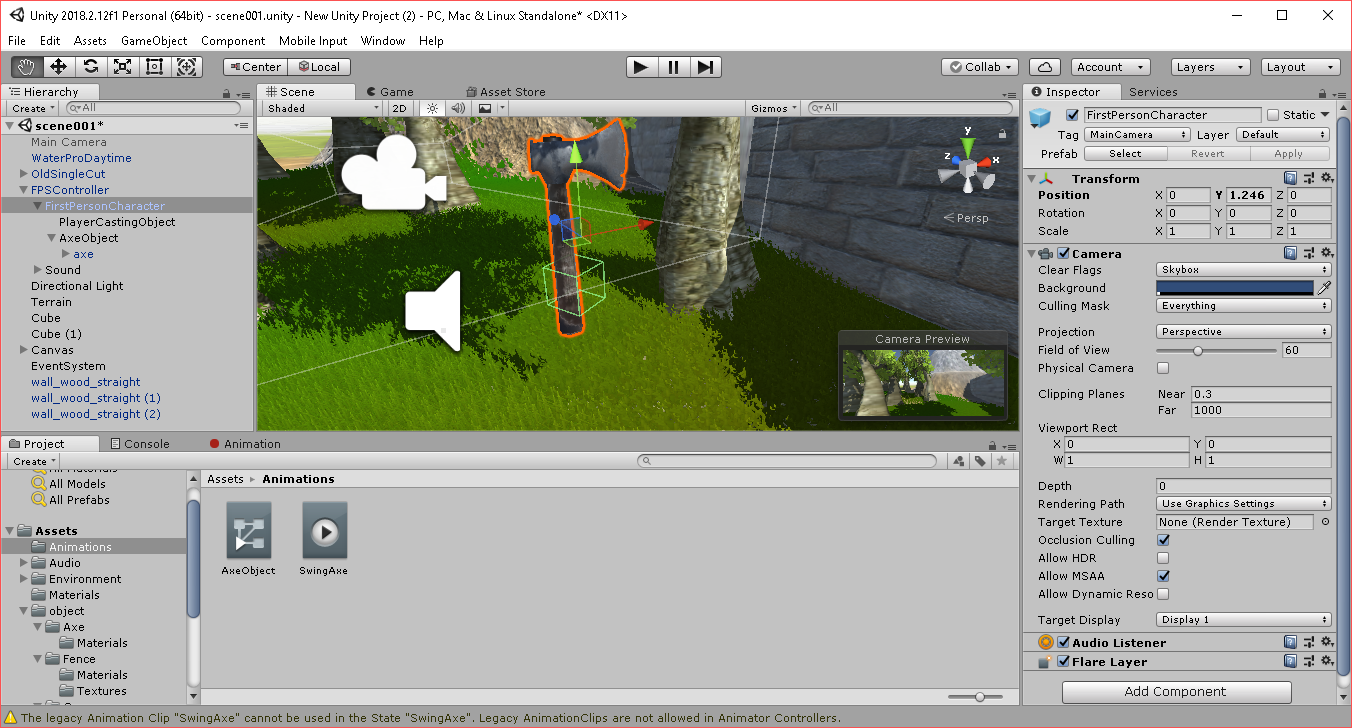
As for making weapon. I was very excited to watch the this tutorial. Adding the axe to the first person character was kind of tricky as my axe was not shown when pressing play mode. I got all the animation working but it is just shown on the screen. Being able to animation the axe is very cool. I had no idea you can do animation on unity. Also on this tutorial i got to learn how to add object such as fences and add component such as box collider so player can not walk pass through. 


Animation of Axe


Tuesday, 23 October 2018

Game GDD

From reading the article, what i think game design document is that a game design document is a highly descriptive living design document of the design for a video game. A GDD is created and edited by the development team and it is used in the video game industry to organize efforts within a development team.These documents are created by the development teams such as artists, designers and programmers to guide throughout the game process.

As reading through, made me realised how much components can have huge affect towards the player and the game. An example of this was " Imagine playing Chess with flat, cardboard counters. It's still the same game but would it be as enjoyable an experience?". The components consists of making the tiles smaller than the spaces they're placed upon. This means that they can be slightly bumped and moved without disturbing all the others. Use highly contrasting/distinguishable colours for player pieces.

The box. 
I think most first impressions of a game come from the box. It does not matter if the game is good to play but if the box does not look attracted then there will be no one to buy it. There are many ways to get people's attention through the box.
Examples :

List the name of the game on the side of the box.
Make sure any "back of the box" photo shows a legal game position. 
Print opposite sides of the box horizontally and vertically.

Game rules are very important to the game design too. Stating your rules to the game  it's a very difficult procedure and one of the hardest things to get right.
There are an amazing number of very common questions that many games fail to answer
Examples:

When exactly does the game end? 
When do you reshuffle cards? 
Is a player allowed to bid more money than she has?
What happens if a player runs out of money during the game? 

There are tips to that a game designer can do to improve a game that does involve spending a money such as support your game online, make replace parts available and include extra components as replacements.

Interested links : 
Design Considerations
https://www.flickr.com/photos/bochalla/5248915179
https://en.wikipedia.org/wiki/Game_design_document


The image on the game box can attract many buyers.
The design of the box has nothing to do with how the game plays.

Thursday, 18 October 2018

Game Vision Statement

3D Runner-Vision Statement

For my vision towards my game is the game will be one player game. 

3D Runner is adventure, simulation and strategy game set on the lost island with lots of adventures and obstacles you will be facing.

Game play is similar to Temple run or other types of running games, with the added twist, interest and excitement of treasure hunting game.

Full 3D game, with 3/4 view camera.

Very fast paced running, with lots of action such as jumping or roll under.

You play as a strong central character who grows, with light RPG elements including: character levels, experience points, stats, and skills.

Collecting items to clear the level, in order to gain access to new area.

link for source used : https://boardgamegeek.com/geeklist/69514/top-10-treasure-hunting-games

Treasre hinting game


Wednesday, 17 October 2018

Unity Tutorial 03

As for tutorial 03 I thought it was going to be working on making the game from recent tutorial. But this tutorial will teach us how to make animated clock using unity engine game.

Making an animated clock is very interesting and fun to do so. I find it much easier now from before such as using game object tools, making parent child or using the transform but still having trouble with viewing different kind of position on the scene panel. 

The tutorial thought me a lot more in coding. i was having trouble with the time such as coding hours, minutes, seconds and making it to rotate. The code that I work with the clock is much different from previous tutorials. It has more commands to it.

During making this project i got confused on adding object into parent child but once i read over and went over my work carefully i was able to figure it out. The lesson that i learned from this is that you must pay attention to even a small detail which can make a huge difference in your project.

What I'm looking forward to next tutorials is to work with more coding as i want to be able to have more practice in coding and to learn more in unity. I can't wait on what i will be doing next!


My Project- Clock

Tuesday, 16 October 2018

Games MDA

   What i have understand from reading and watching the link that was provided for us on cdmonline is in game design the Mechanics-Dynamics-Aesthetics framework is a tool used to analyze games.
 It formalizes the consumption of games by breaking them down into three components: Mechanics, Dynamics and Aesthetics. These three words have been used informally for many years to describe various aspects of games, but the MDA framework provides precise definitions for these terms and seeks to explain how they relate to each other and influence the player's experience.

-   Mechanics are the base components of the game - its rules, every basic action the player can take in the game, the algorithms and data structures in the game engine etc.
-   Dynamics are the run-time behavior of the mechanics acting on player input and "cooperating" with other mechanics.
-   Aesthetics are the emotional responses evoked in the player.

There are eight type of Aesthetics as stated by Hunicke, LeBlanc and Zubek:

1. Sensation (Game as sense-pleasure): Player experiences something completely unfamiliar.

2. Fantasy (Game as make-believe): Imaginary world.

3. Narrative (Game as drama): A story that drives the player to keep coming back

4. Challenge (Game as obstacle course): Urge to master something. Boosts a game's replayability.

5. Fellowship (Game as social framework): A community where the player is an active part of it. Almost exclusive for multiplayer games.

6. Discovery (Game as uncharted territory): Urge to explore game world.

7. Expression (Game as self-discovery): Own creativity. For example, creating character resembling player's own avatar.

8. Submission (Game as pastime): Connection to the game, as a whole, despite of constraints.

Condra Game
Example is Condra Game. X has some data like a position and actions such as jumping. Since his piece of data its a Mechanic and since jumping is an action is also a mechanic.

This image contains numbers of mechanics. Firstly you can see some data. X himself has a position and as well as the enemies. When x touches the enemies he takes the damage.

link informations:


Sunday, 14 October 2018

Feedback Strategies

Feedback Strategies

Feedback is about giving information in a way that encourages the recipient to accept it, reflect on it, learn from it, and hopefully make changes for the better. Being able to give feedback is a skill that is useful in your personal and professional lives. 

The two article that i want to write about are:

Be a mirror and Five Reasons to Stop Saying "Good Job"

Be a mirror

I like the phrase "Be a mirror" as i think it is very catchy phrase. I think being a mirror to someone is to understand and gain their importation information. After knowing their information we then can give feedback on our thoughts about their information or share our own experience. We are not meant to judge them as the mirror job is to reflect back. 

one of the quality feedback is to focus on the process and the work on the reader put in. When we focus on the process. We can show their effort on the work and it is valued and important.

Giving feedback can make plenty of changes in their work such as improving or understanding more of the concept.

Five Reasons to Stop Saying "Good Job"

From reading the article there are topics that i liked reading and want to talk about them.

Losing Interest:

For example of this is when a kid is doing something as painting or drawing.  Stop saying "Good Job" and say "Good painting!" may get children to keep painting for as long as we keep watching and praising. It encourage the children to do well  and to complete on their drawings. 

It is said by Lilian Katz, one of the country’s leading authorities on early childhood education, "once attention is withdrawn, many kids won’t touch the activity again." Indeed, an impressive body of scientific research has shown that the more we reward people for doing something, the more they tend to lose interest in whatever they had to do to get the reward. 

Now the point isn’t to draw, to read, to think, to create – the point is to get the goody, whether it’s an ice cream, a sticker, or a "Good job!"

Be a mirror

The mirror is reflecting/ showing the care to safety path.